
Quiz for Rick and Morty
Robbie EliasTrivia
4.625.00 Reviews
- Version
- 1.3.1
- Installs
- 10.00K
- Age Rating
- Teen
Screenshots
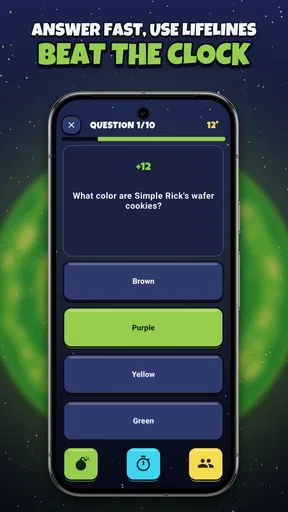
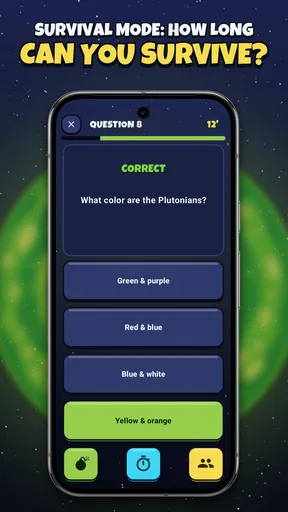
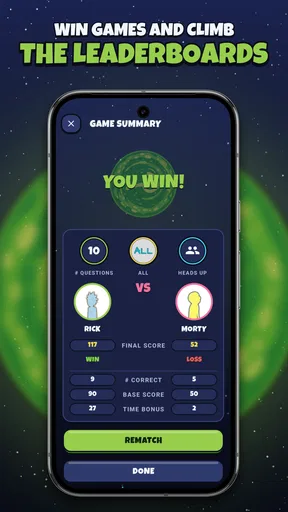
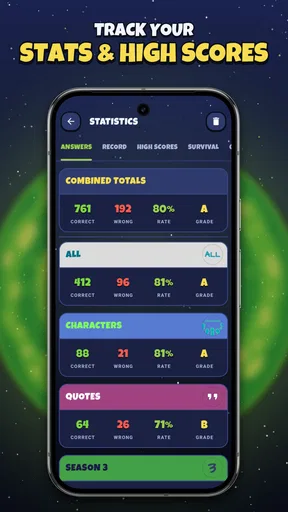
Our Review of Quiz for Rick and Morty
 Analysis by Appyee
Quiz for Rick and Morty is the kind of trivia game I open when I want a short burst of fandom rather than a large, feature-heavy mobile experience. It is a fan-made quiz built around the animated series, developed by Robbie Elias, and its appeal is easy to understand: it turns recognition of characters, events, jokes, and story details into a quick test of memory. I found it most enjoyable when I treated it as a casual challenge between episodes, not as a replacement for a full game.
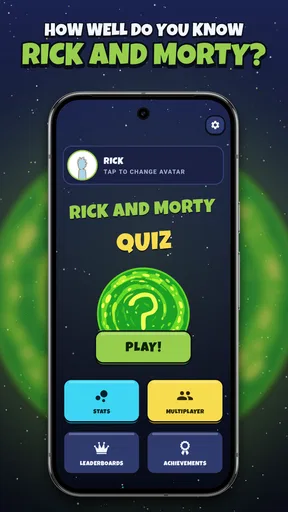
The first impression is deliberately simple. There is no need to learn a complicated control scheme or spend time building a character. The central activity is answering questions about Rick and Morty, so the game gets to its point quickly. That directness suits the subject. A trivia title about a fast-moving show can lose its charm if menus and extras get in the way, while this experience works best when the question is the focus.
After spending time with it, my view is fairly clear: this is a compact fan quiz with a strong social and replay value, but limited appeal outside the Rick and Morty audience. If you know the show well, it can expose gaps in your memory and create amusing arguments with friends. If you have only seen a few episodes, some questions may feel less like a fair test and more like a reminder that the series has a deep catalog of details.
A fan quiz that understands its own mood
I frame this section around the game’s narrow focus: it works best as a quick memory test for people who already enjoy Rick and Morty, not as a broad trivia destination. That distinction matters when deciding whether to try it, because the same simplicity that makes it easy to pick up also limits how long it can hold attention. Next, I turn to what makes that focused approach worthwhile in practice.
The first few rounds and the right expectations
The game’s strongest quality is its focus. Instead of trying to become an all-purpose trivia platform, it stays tied to one fictional universe. That makes the experience immediately recognizable to fans. I did not approach it expecting elaborate progression, cinematic presentation, or a broad range of subjects. I approached it as a knowledge check, and that expectation made the simple format feel appropriate rather than underdeveloped.
It is free to start, which makes it easy to try without committing money first. Optional in-app purchases are listed at $1.99 per item, so anyone who prefers a completely purchase-free experience should keep that in mind before spending time with it. The sensible approach is to begin with the free experience and decide whether the extra value suits your own habits. For a short trivia game, I would not recommend buying anything until you know you will return to it regularly.
The game is rated Teen, a fitting classification for a title connected to a show known for mature jokes, violence, and unusual science-fiction situations. That rating also helps set expectations for parents. It is not presented as a general children’s quiz, and I would not choose it for younger players simply because the format looks light.
On Android, the listed minimum requirement is version 6.0, which keeps the potential audience fairly broad. The current version is 1.3.1. I would still treat compatibility as something to check on the individual device, especially if you are using an older phone or tablet, because a low operating-system requirement does not guarantee identical performance on every model.
Why the setting matters more than it first appears
A generic trivia app can ask about anything, but that breadth often weakens its identity. Here, the setting supplies the identity. Rick and Morty has a distinctive mixture of science fiction, family conflict, absurd creatures, alternate realities, and deliberately chaotic humor. Even when the mechanic is simply choosing an answer, the subject matter gives each question a recognizable flavor.
The art direction benefits from that same focus. A fan-made game does not need to imitate every visual detail of the television series to feel connected to it. What matters is whether the interface supports the mood of the source material instead of looking like a completely unrelated quiz. In my experience, the concept works because the quiz is framed as part of the fandom rather than as a neutral exam.
That distinction is useful when deciding whether to install it. Someone searching for a polished general-knowledge game may find the presentation too narrow. Someone who wants to test knowledge of fictional worlds will understand the choice immediately. The setting is not decoration around the questions; it is the reason the questions are worth answering.
Art direction and the language of the show
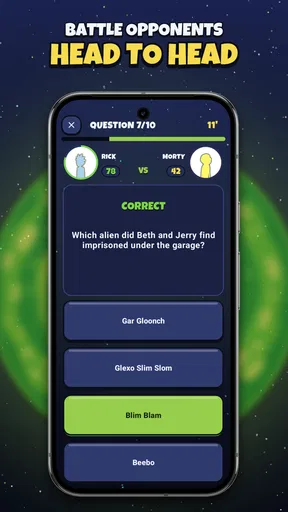
The visual identity of a Rick and Morty quiz has a difficult job. It needs to feel playful and strange without making the answer screen hard to read. Good trivia design depends on quick recognition: I should be able to see the question, compare the choices, and make a decision without fighting the interface. The fan-made framing gives the game permission to be informal, but clarity still matters more than spectacle.
I also think the visual connection changes how players remember mistakes. In a plain quiz, getting an answer wrong can feel like a small failure with no personality. In a show-specific quiz, the wrong answer can send me back to a scene, character, or story arc in my memory. That makes the learning loop more entertaining, even when the game does not behave like a formal study tool.
One practical tip is to play with the show’s episodes fresh in your mind. A recent viewing session gives you a useful memory advantage, but it also reveals whether you are remembering the important story or merely the loudest jokes. Playing immediately after watching can turn the quiz into a second pass through an episode, while playing after a longer break makes it a more honest test of long-term recall.
Sound, silence, and the pace of answering
Sound has a different role in a trivia game than it does in an action game. It does not need to create a large cinematic world; it needs to support the rhythm of question, decision, result, and next attempt. For me, the ideal mood here is quick and lightly comic, with enough feedback to make a correct answer feel satisfying without slowing the session down.
This is also where a small quiz can feel either lively or flat. If the transitions are brisk, I can settle into a useful rhythm and answer several questions during a short break. If the presentation interrupts that rhythm, the subject matter alone cannot carry the whole experience. The best way to use it is in short sessions, where its compact structure feels intentional instead of repetitive.
I would not install this specifically for a rich audio experience. Its primary attraction is the quiz content and the atmosphere associated with the series, not a soundtrack-driven presentation. Players who normally judge mobile games by elaborate music, voice work, or dramatic effects should keep their expectations modest.
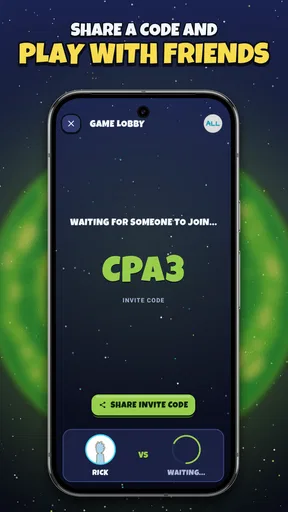
There is a simple everyday use case here. Imagine meeting friends who all watch the show but disagree about who remembers it best. A few rounds can work as a quick conversation starter while waiting for food or during a relaxed evening. The game gives the group a shared subject, and the disagreements over obscure details can become more entertaining than the score itself.
How the mechanics fit the source material
The core mechanic is a natural match for the license-inspired setting: recall information, select an answer, and see whether your memory holds up. That sounds basic, but basic is not automatically bad. Trivia works when the questions create tension between confidence and uncertainty. I often knew the broad scene but hesitated over a specific detail, which is exactly the kind of friction that makes a quiz worth playing.
The trade-off is depth. A question-and-answer structure cannot offer the same variety as a puzzle game, adventure, or strategy title. Once I understood the basic loop, the long-term value depended almost entirely on the quality and range of the questions. Fans who enjoy collecting knowledge may return often, while players who need constant mechanical change may move on quickly.
This is where it differs from the usual alternatives in the category. General trivia apps offer variety across history, science, sports, entertainment, and geography, so they are better for broad knowledge or mixed group play. A dedicated Rick and Morty quiz is better when the group already shares the same reference point. The choice is not really between two identical products; it is between breadth and fandom depth.
It also differs from watching the series. Watching gives context, timing, animation, and character performance. The quiz removes those supports and asks what remains in memory. I would use the game after watching, not instead of watching. It can refresh details and encourage discussion, but it cannot deliver the storytelling experience that made those details memorable in the first place.
Who will get the most from it
The clearest audience is an active Rick and Morty fan who enjoys testing recall. It is especially suitable for people who like small challenges, friendly competition, and the satisfaction of recognizing a detail that another player missed. Because the game is free to begin, it also works for curious viewers who want to see whether a dedicated quiz matches their level of interest.
It can be useful for different levels of fandom, although the experience will not feel identical. A newer viewer may enjoy questions about familiar characters and major events, while a long-time fan may be looking for obscure references and minor details. The latter group is likely to gain more replay value, because a deeper knowledge base makes the challenge more rewarding.
I would skip it if you do not enjoy the show, dislike entertainment-specific trivia, or want a game with exploration and active controls. I would also choose a general trivia app instead if the goal is to learn about many subjects. This title is not a flexible knowledge tool; its narrow focus is both its best feature and its biggest limitation.
Useful ways to play without making it feel like homework
My first recommendation is to separate solo and group sessions. Alone, I used the game as a memory check and paid attention to which kinds of details I repeatedly missed. With friends, I cared less about perfect accuracy and more about the explanations and arguments that followed each answer. Treating both modes the same can make the game feel less rewarding than it needs to be.
A second tip is to avoid looking up answers immediately. If a question feels familiar but uncertain, give yourself a moment to reconstruct the scene before choosing. That small pause turns the game from rapid guessing into active recall. Afterward, revisit the episode or discussion only when you genuinely want to settle the issue. This approach gives the quiz more value than simply tapping the most recognizable option.
A third trade-off involves spoilers. A show-based quiz can reveal that certain characters, locations, or events are important before you reach them naturally. New viewers who want to experience the series without hints should play cautiously, particularly if they are only partway through the episodes. Established fans have less to worry about, but the quiz still works best when the player is comfortable with material from across the show.
Another practical choice is session length. I would play in brief bursts rather than forcing a long marathon. Short sessions preserve the novelty of the questions and make the pace feel energetic. A long session can expose the limits of a focused trivia format, especially if you are not learning anything new from the mistakes. Stopping after a satisfying round is better than continuing until the subject feels repetitive.
What the ratings and audience size suggest
The game holds a 4.6 average from around 188 ratings, with about 25 written reviews, and it has passed 10K installs. Those figures suggest a small but clearly interested audience rather than a massive mainstream game. I read that as a useful signal: the people who find the concept appealing seem to respond well, but the experience is naturally limited by its specialized subject.
That audience profile should shape your expectations. A large general trivia platform may receive frequent attention because it serves many interests, while this fan-made project depends on a specific community. Its smaller scale can feel personal and focused, but it also means I would not compare it directly with major quiz platforms that offer broad categories, extensive social systems, or a much larger content pipeline.
Where the design feels most coherent
The best part of the experience is the agreement between subject, mood, and mechanic. Rick and Morty is built around surprising information, strange worlds, and details that can be easy to miss. A trivia format turns those qualities into the challenge itself. The art direction establishes the fan context, the sound and transitions support short bursts, and the questions give the player a reason to keep testing memory.
The weakest point is also clear: the atmosphere cannot hide a limited core loop forever. Once the novelty of the setting fades, the game must rely on question variety and the player’s personal attachment to the show. That is not a criticism of the concept so much as an honest boundary. It is a focused quiz, and it should be judged as one.
For me, the most convincing reason to keep it installed is social. It is easy to hand the phone to another fan, compare answers, and turn a quiet moment into a small contest. The least convincing reason would be expecting a full game with a story, exploration, or a deep progression system. Choosing it for the wrong reason will make its simplicity feel like a flaw.
My verdict for fans deciding today
Quiz for Rick and Morty succeeds because it does not need to explain why its subject is interesting. The show already provides the characters, worlds, and memorable details; the game turns that material into a compact test. I enjoyed it most when I played casually, accepted that some questions would be difficult, and used the results to revisit scenes in my memory.
Robbie Elias has aimed at a clear audience, and the result makes sense for that audience. The free entry point lowers the risk of trying it, while the Teen rating and optional $1.99-per-item purchases are details worth considering before sharing it with younger players or spending money. Its Android requirement of 6.0 or later also makes it approachable for many devices, and the current 1.3.1 version gives users a straightforward edition to try.
I would recommend it to fans who want a quick, themed challenge and to groups looking for a playful way to compare their knowledge. I would point general trivia players toward a broader alternative, and I would steer action-game fans elsewhere. In the right hands, this is an enjoyable little fandom test: focused, easy to pick up, and most effective when its questions lead to conversation rather than just a final score.
Verdict
Strengths of Quiz for Rick and Morty
- Covers characters, episodes, and memorable moments from the series.
- Short questions make it easy to play during quick breaks.
- Simple interface is accessible for casual fans of all ages.
- Good replay value when trying to improve your score.
- Can spark interest in revisiting episodes and storylines.
Limitations of Quiz for Rick and Morty
- Some questions may feel too easy for dedicated Rick and Morty fans.
- Content can become repetitive after several quiz sessions.
- May include unofficial material or inaccurate details.
- Limited appeal if you have not watched much of the series.
- Ads or in-app purchases may interrupt the quiz experience.
Similar Picks in This Category
View All
Millionaire 2026 Quiz & Trivia
Quiz & Trivia Games by Submarine Apps4.5

Brain Test 2: Tricky Stories
Unico Studio4.7

Trivia Crack: Brain Quiz Games
etermax4.4

QuizzLand. Quiz & Trivia game
Quiz & Trivia Games by Mno Go Apps4.8

Brain Test: Tricky Puzzles
Unico Studio4.7

Logo Quiz
bubble quiz games4.5
Frequently Asked Questions
What is Quiz for Rick and Morty?
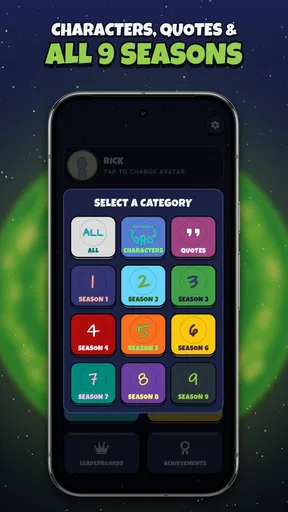
Quiz for Rick and Morty is a fan-made trivia game based on the animated series Rick and Morty. It challenges players to identify characters, episodes, quotes, locations, inventions, and memorable moments from the show. The app is designed for casual entertainment and tests how well you remember the series rather than offering official episodes or interactive access to the show itself.
Does Quiz for Rick and Morty include all seasons and characters?
The available content can vary depending on the app version and its latest updates. It generally focuses on recognizable characters, stories, and references from Rick and Morty, but it may not cover every episode, minor character, or recent season equally. Before downloading, check the store description and update notes to confirm whether the content matches the seasons you have watched.
Is Quiz for Rick and Morty suitable for children?
Parents should review the game’s age rating before allowing children to play. Although it is presented as a quiz, the questions may refer to the show’s mature humor, science-fiction violence, adult themes, or language. The game itself may be simple to use, but familiarity with Rick and Morty’s content is usually intended for older viewers rather than young children.
Does the quiz require an internet connection or contain advertisements?
Requirements depend on the specific version available for Android or iOS. Many fan-made quiz apps can be played offline after installation, while others may need an internet connection for advertisements, analytics, updates, or certain features. Free versions commonly include ads, and some may offer optional purchases. Review the permissions, store listing, and in-app purchase information before installing.
Is Quiz for Rick and Morty an official game from the creators of the series?
Quiz for Rick and Morty should not automatically be considered an official product of Adult Swim, Warner Bros., or the show’s creators. It is typically a fan-made trivia experience using references associated with the series. If official licensing matters to you, check the developer name, publisher information, and app-store description carefully. Avoid assuming that the presence of the show’s name guarantees official approval.
Play our best games!


